
Just as in buying a house, the #1 question I hear from people looking to sell their house is “where do I start?”
I get it. This is my everyday life but for most people, this isn’t a process they experience very often (if they’ve experienced it at all up until this point). A house is such a large component of your overall net worth (both as an asset and as a debt) and it’s not something you take lightly.
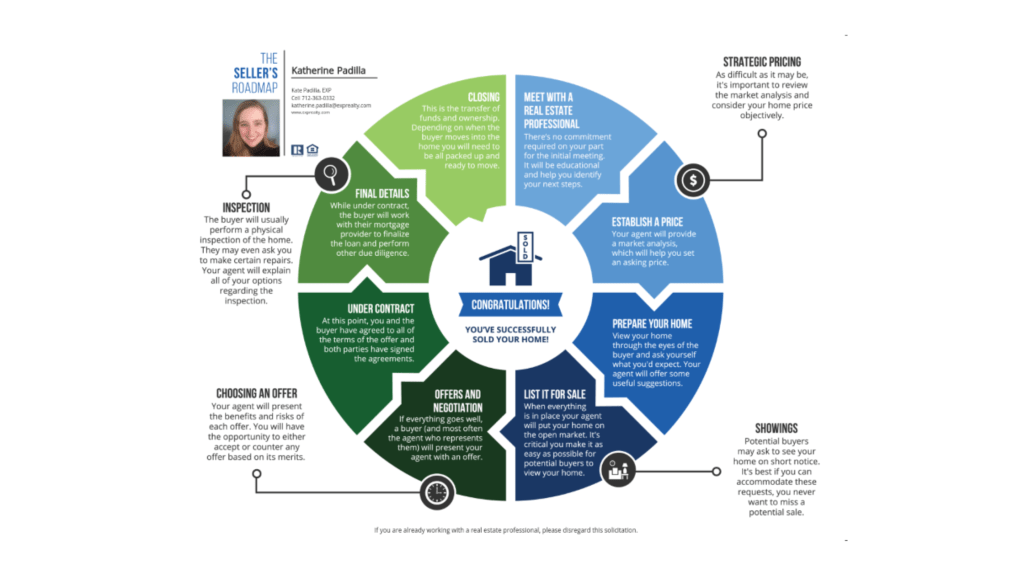
Fortunately, it is a process with clear and defined stages. And, with the right team around you, it doesn’t have to be as overwhelming as it may seem. Selling a house involves around eight steps, from beginning to end.
(If you’re more of a visual person, you can refer to the graphic within this post. You can also download it as a PDF for easy reference).
Step 1: Meet with a Real Estate Professional
Finding the right realtor is key in the sale of your home. You want someone who a) knows what they’re doing, but also b) can work well with you. Just like any other professional, each realtor in an area has something different to offer, and a different style of doing business. It is important to find one that provides what you’re wanting, both in business practice and in personality.
Chances are, you already know a realtor, or you know someone who does. And this is great — referrals are one of the easiest ways to find someone to do business with. In fact, in 2020, NAR reported that 68% of home sellers found their realtor through a referral from a family member or friend. If someone you know and trust has had a good experience with someone, give them a call and schedule an appointment.
But what comes next? How do you know that this person will also work well for you? Ask questions! Realtor has a good list to start with if you’re unsure of what to ask. You’re looking for the following answers:
- How does the realtor conduct their business? What is their marketing plan? How do they come up with the price points they believe will best sell your house?
- How well does the realtor know their own business? You don’t necessarily need the one that has the highest sales volume or the most number of properties under contract. What you’re looking for is the knowledge — being a realtor means running a business. You want someone who knows their numbers, whatever those numbers may be.
- How well does the realtor know the market? Imagine selling something you know nothing about. A realtor should know the market well enough to competently list your home at an appropriate price point, based on your needs for the sale of the house.
Step 2: Establish a Price
I attended a seminar last year that gave me a really great point of insight in pricing houses within the context of a market analysis (in industry lingo, it’s often called a “CMA”).
In this seminar, the realtor presenting was ultimately talking about creating processes and systems, but in the moment he talked about how his office conducts listing presentations. Specifically, the market analysis. When they present the report to the prospective client, they present three price points. The lowest price is designed to sell the house quickly. The highest price is designed to sell the house for the most amount of money. The mid-point price is designed to compromise between time and profit.
I really liked this practice, and I started adopting it into my own presentations. But, regardless of where I believe a house should sell, pricing and selling a house is not a purely objective process. You, as the seller, do have an idea as well on where you believe (or want) the home to be priced. Maybe it’s due to the money you put into the house in the time that you owned it. Maybe it’s due to the other houses in your neighborhood that have sold within the last few months. All of this is totally understandable. The key in pricing your house appropriately is finding that common point between your experience in your home and neighborhood and the realtor’s knowledge of the market overall.
Step 3: Prepare Your Home
Your realtor will likely give you tips on how to style your home to attract the right buyer (i.e., the one that will make an offer on your home). The good news is that most of the elements that influence a buyer’s first impression of your home are completely controllable:
- Cleanliness (including ‘clutter’ and odors)
- Décor
- Condition (including lighting)
Of course, some things you can’t control — such as the floor plan or the number of rooms. But the three things above account for about 72% of a buyer’s initial impression.
Go through your home as if you were a buyer, taking a careful look at these three things: the cleanliness, the décor, and the condition. How can you present your home at its best?
Step 4: List it for Sale
The time has come. Your home has been buffed and polished, and it’s ready to hit the market.
Your realtor will likely have a marketing plan of strategies they have found work best in your local market. But there are also thing you can do in order to best sell your home.
- Keep the house clean
- Be responsive when your realtor reaches out with a showing request
- Consider all feedback, and make adjustments as needed
Step 5: Offers and Negotiation
Congratulations! You’ve received an offer on your house. By law, your realtor must present all offers that come in, regardless of what price the buyer offers or what the rest of the contract looks like.
Keep this in mind: Your goal is to get the most amount of money for the least amount of concessions, and a buyer’s goal is to pay the least amount of money for the most amount of value. There will (almost) always be a middle ground, and this sweet spot is where both of you can agree.
Step 6: Under Contract
Once all the initials and signatures are on the page, the behind-the-scenes work begins. Your buyer may likely want an inspection, and has a fairly short window of time in order to conduct this process. And while the buyer is doing their due diligence, and their lender is getting the loan ready, you are busy packing and prepping to move to your new place.
When first reading the contract and seeing a tentative closing date a month or so into the future, it may seem like a long time. But trust me, these days go by quickly. Don’t sit around and wait until the last moment. You will only add additional stress to the process.
Step 7: Final Details
The due diligence has been conducted. The loan is finished. Closing day is on the horizon.
Here are some last-minute tips:
- Hire a cleaning service after you’ve finished moving out. It is an additional cost, of course, but it will save you time (and likely sanity as well).
- Your realtor will have a set of keys to transfer to the buyer, either through the buyer’s agent or through a closing professional. As you find additional keys or garage door openers, leave them in a central (and easy-to-see) location for the buyer.
- Take a final walk through the house before leaving for the final time. Look for little things you may have forgotten, yes, but take a deep breath and soak in the memories you had in the home while you lived there.
Step 8: Closing
You’ve made it. The “t”s are crossed, the “i”s are dotted, the movers have come and the keys are transferred.
Again, your realtor may have final details on your particular home and circumstances, but–generally speaking–after you sign your side of the closing paperwork and the buyer signs theirs, any outstanding creditors will be paid (mortgagor, county recorder, etc.) You will receive the balance shortly after.
This may seem simplistic, and it is. In reality, there are no two houses–or sales thereof–that are exactly the same. But this short overview should give you a general idea of the process in selling your house, from reaching out to a realtor to signing the final paperwork.
As always, if there are additional questions (or things you found confusing), I’d be happy to find answers for you. Reach out to me via my Contact Page or by email at katherine.padilla@exprealty.com.
 Kate Padilla
Leave a comment